The Bee Dance
July 7, 2020 9:00pm IST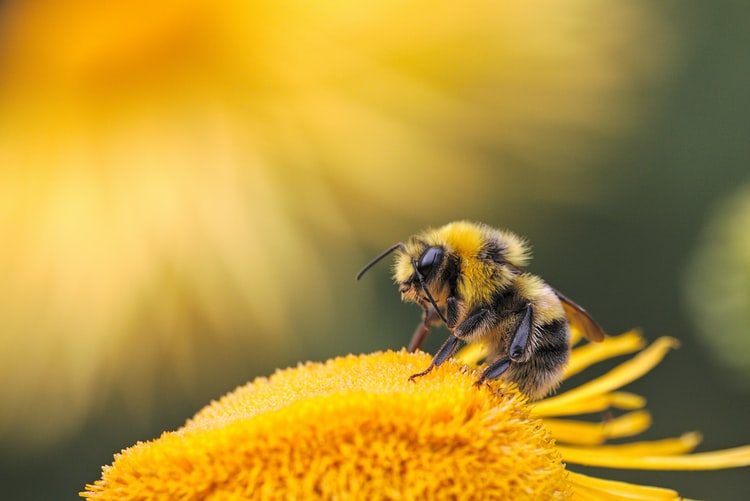
If you are a keen observer, then you must have seen honey bees (Apis sp.) waggling around. Ever wondered, what is the reason behind this? Is it just for fun? Or are the bees really inspired by Michael Jackson!? Well, these little creatures are much smarter than what we can think of and use this dance as a means of communication! Dr. Karl von Frisch, who was awarded the Nobel Prize for his research on the honey bee dance, was himself astounded about what he found.
Undoubtedly, the honey bee dance is one of the most famous aspects of honey bee biology. This unique form of communication allowed bees to share information on the location of food sources with nest-mates. This dance is sometimes referred to as the waggle dance, although the waggle dance is one of the dances performed by the honey bee. The two main informations which are communicated via this method are telling a swarming colony about the location of a potential new home, and communicating to its sisters the distance and location of food and also water.
Round dance is performed by the bees when the food source is close to the hive, i.e. less than 50 metres. Quite interestingly, the closer the food source is, the more number of ‘rounds’ are performed by the bee. This dance communicates only about distance, and not direction. After the round dance has ended, the bee often distributes food to the bees following her. When the food sources are at a distance about 50-150 metres, sickle dance is performed. The form of this dance is crescent-shaped, a transitional dance between a round dance and a figure-eight waggle dance.

A waggle dance, or wag-tail dance, is performed by bees foraging at food sources that are over 150 meters away from the hive. This dance, unlike the round and sickle dances, communicates both distance and direction to potential recruits. A bee that performs a waggle dance runs straight ahead for a short distance, returns in a semicircle to the starting point, runs again through the straight course, then makes a semicircle in the opposite direction to complete a full, figure-eight circuit. As the distance to the food source increases, the duration of the waggling portion of the dance also increases. The relationship is roughly linear. For example, a forager that performs a waggle run that lasts 2.5 seconds is recruiting for a food source located approximately 2625 meters away.
The method of communicating direction is more complicated and abstract. The orientation of the dancing bee during the straight portion of her waggle dance indicates the location of the food source relative to the sun. The angle that the bee adopts, relative to vertical, represents the angle to the flowers relative to the direction of the sun outside of the hive. In other words, the dancing bee transposes the solar angle into the gravitational angle. Conversely, if the food source were located directly away from the sun, the straight run would be directed vertically down. If the food source were 60 degrees to the left of the sun, the waggle run would be 60 degrees to the left of vertical. The honey bee has to change the angle of the dance as the sun changes position through the day! Clouds, tall buildings, trees or other obstacles obscuring the sun require the bee to use her knowledge of ultraviolet light and polarization by analysing the intensity of light.
There are other factors, like the amount of wind, which are taken in account by these clever bees! A strong headwind will cause the bee to dance as if the food was further away, thus indicating that more energy will be expended to reach this source of food.
Who would have thought that dancing would have been such an effective source of communication for these little creatures!
Author :
ANCHITA SHARMA
Related Articles
Why And How Ants Move In Queues?
November 12, 2020 4:47pm IST
We have all seen the ants walking along a line towards a food source. But have you thought about how they could be so precise in their movement? Are there any traffic ants or road maker ants that make sure that ants walk in a designated path? They sure don’t have GPS to navigate their way around.
Wiggle-Waggle for Survival
August 27, 2020 10:00am IST
While peacocks are known for their bonnie dance, these peacock spiders are known for hokey pokey dance showing off their stylish fans. Both perform to please the females,
Communication in Insects
August 29, 2020 3:30pm IST
For humans, it is easier to communicate with each other. We have different languages which we speak and sometimes translate so that people from other countries can also understand.