The World From A Dragonfly’s Eyes
April 1, 2021 12:10 pm IST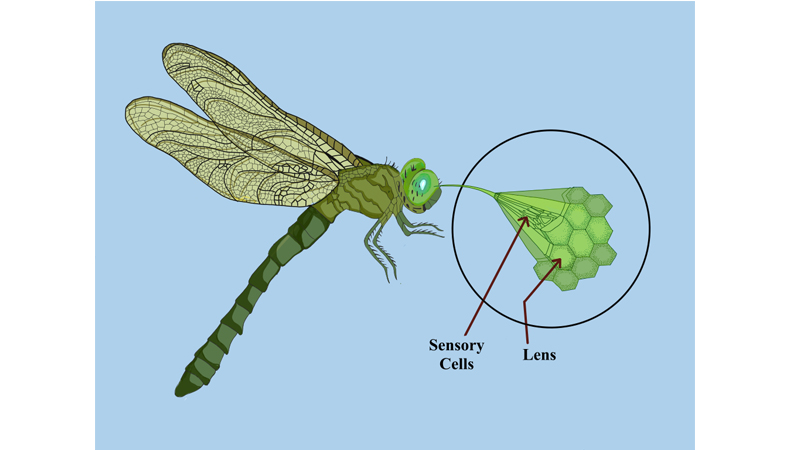
Many arthropods have compound eyes which are collections of many lenses called ommatidia, which gives them much more superior vision as compared to other animals with only one lens. This provides them with a wider vision with much more color variation. One of the most fascinating members of class Insecta, the dragonflies, are said to have the best vision in the whole animal kingdom. The simple colour vision of humans is dependent on red, green and blue opsin proteins (light sensitive proteins). Each type of opsin absorbs one colour of light in the spectrum and the different wavelengths of light reflected from objects mix together, enabling humans to see some 10 million different colours. Compared to the simple eyes of humans, the compound eyes of dragonflies have as many as 33 opsins in them. Therefore, it is considered that dragonflies can see the colours that are beyond human visual capabilities, which means that these creatures can see the UV light too!
The large compound eyes of dragonflies are made up of about 30,000 units (called ommatidia) that cover most of the part of its head and provide it a very wide view of vision. Although the image produced by these compound eyes is not as sharp as that of humans, they are considered to be one of the clearest among the insects due to the incredibly large number of ommatidia. The scattered visual units give dragonflies a visual range of almost 360 degrees! Moreover, each unit is highly sensitive to any movement happening and hence, making the dragonfly quick to respond to even the slightest change in its surroundings. It has also been seen that dragonflies can detect the plane-polarized light which they may use as a compass for navigation purposes.
Both dragonflies and damselflies are closely related and shared an ancestor over 250 million years ago and provide an insight into how the ancient neural system controlled such precise and quick aerial hunts(5). Dragonflies are excellent hunters with a success rate exceeding 95%! The small visual units can send information in a fraction of a second and can also detect their prey’s route and speed. They are considered to be so precise that they can pick an individual insect from a swarm and fly through it without colliding with others. This ability of focusing on just one target is comparable to that of humans.
It is also said that dragonflies perceive the world in slow motion! Dragonflies experience time in a completely different way than us. They have a much faster reaction time than ours. In a study by BBC, the human vision was compared to the super sense of dragonflies by considering the example of a flicker book. If we flip the book fast enough, then we can see the images in it to be animated because we can hardly notice the turning of each page. Where our eyes can capture upto 60 images per second, the dragonflies can see around 200 and observe things that are just too fast for even the human brain to process. This means that dragonflies will be able to see the turning of each page of the flicker book!
This fast and wide vision of Dragonflies is what makes them very efficient hunters and allows them to avoid predators. They catch insects as large as themselves, avoid predators like birds, frogs or other insects.
References:
Author :
Anchita Sharma
Related Articles
The beatiful Dragon
NewYou must have seen beautiful dragonflies fluttering their wings. But do you know, Dragonflies spend most of their life span as swimming larvae in small streams and ponds ? Dragonflies are ferocious predators, they feast on insects. Today, the Dragonfly population is decreasing across the globe. Their conservation is necessary....

Why And How Ants Move in Queues?
NewWe have all seen the ants walking along a line towards a food source. But have you thought about how they could be so precise in their movement? Are there any traffic ants or road maker ants that make sure that ants walk in a designated path?...
Why do Scorpions glow under UV light?
NewWe have all seen the ants walking along a line towards a food source. But have you thought about how they could be so precise in their movement? Are there any traffic ants or road maker ants that make sure that ants walk in a designated path?...