Why Do Scorpions Glow Under UV Light ?
August 29, 2020 12:30pm IST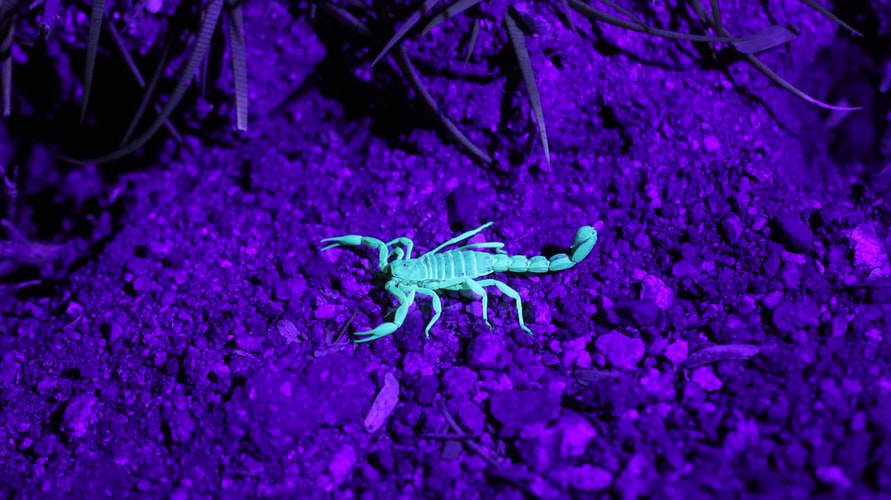
Have you ever seen a scorpion under moonlight or UV light? Do you know that these magnificent creatures glow in blue-green color?
Here we will discuss how these neon-colored, party-ready creatures can bring fun to a Scorpions (band) concert.
If you’ve ever seen a scorpion under rich moonlight or UV light, you could see that its exoskeleton glows in blue-green color. The exoskeleton’s color comes from the presence of chemicals like β-carboline and 7-hydroxy-4-methyl coumarin in the hyaline layer, a thin but strong coating called the cuticle.
There’s been a great observation that right after a scorpion molt, meaning that it sheds its shell, the scorpion loses its ability to glow, and it doesn’t glow until the new cuticle forms. This observation suggests that the chemicals that cause fluorescence are formed in the exoskeleton during the hardening process. The shell also has some fantastic properties, which also helps the glow be super long-lasting. The hyaline layer is very durable: it can survive millions of years, and even after that amount of time, the layer still fluorescences!
Having discussed at its fluorescence properties, let us look at the behavioral mysteries surrounding its glow. Though we have quite an idea about its glow, we still have a lot to figure out about the evolutionary advantage to the scorpions. Some scientists believe that the glow is used to lure their prey. The glow could send a warning to the predators or help the scorpions recognize each other, although these possibilities still need to be scientifically verified. David Gaffin from the University of Oklahoma has a different perspective on this. He thinks that they convert UV to blue-green light because it is the radiation that they see the best. This theory explains why the scorpions can detect even the faint glow of starlight.
In 2010, Carl Kloock found evidence for this idea. He overexposed the scorpions with UV light. He found that the scorpions that still glow, hide themselves to a sheltered area, while the unexposed scorpions spent time outside. Proceeding this, Gaffin decided to see how the eastern sand scorpion (Paruroctonus utahensis) would behave when exposed to different frequencies of light. He observed that the behavior was similar to when exposed to blue-green and UV light. This experiment provides more evidence to his idea that they’re using their glow to detect UV light, which they couldn’t else detect just with their eyes. As they’re nocturnal creatures and in the night time, UV light is more common in the sky than the visible light that we see.
Gaffin thinks that due to this, the scorpions might be able to use the UV light, and the whole body could be sending signals to the brain via a cluster of nerves. This possibility can enable them to use their whole body as a big eye and provide a significant advantage during the night. However, this idea still needs to be experimentally verified.
Author :
ANHAD SINGH BAGGA
Related Articles
Camouflage: A strategy for survival
November 12, 2020 6:45pm IST
VertIf we look into the Oxford dictionary for the meaning of camouflage we will get: “the way in which an animal’s colour or shape matches what is around or near it and makes it difficult to see”. They use it as a defensive mechanism as well as an offensive mechanism.
The Bee Dance
July 7, 2020 11:00pm IST
If you are a keen observer, then you must have seen honey bees (Apis sp.) waggling around. Ever wondered, what is the reason behind this? Is it just for fun? Or are the bees really inspired by Michael Jackson!? Well, these little creatures are much ...
Spider- A Layperson’s Insect
August 5, 2020 8:50pm IST
'Is a spider an insect?' Most of us, if asked, will answer yes. But is the answer correct? Let us try to find out. The word insect stems from the Latin word insectum,
Wiggle-waggle for survival
August 27, 2020 10:00am IST
While peacocks are known for their bonnie dance, these peacock spiders are known for hokey pokey dance showing off their stylish fans. Both perform to please the females,